How to understand math formulas
By Murray Bourne, 19 Feb 2009
In a recent IntMath Poll, many readers reported that they find math difficult because they have trouble learning math formulas and an almost equal number have trouble understanding math formulas.
I wrote some tips on learning math formulas here: How to learn math formulas.
Now for some suggestions on how to understand math formulas. These should be read together with the "learning" tips because they are closely related.
a. Understanding math is like understanding a foreign language: Say you are a native English speaker and you come across a Japanese newspaper for the first time. All the squiggles look very strange and you find you don't understand anything.
If you want to learn to read Japanese, you need to learn new symbols, new words and new grammar. You will only start to understand Japanese newspapers (or manga comics ^_^) once you have committed to memory a few hundred symbols & several hundred words, and you have a reasonable understanding of Japanese grammar.
When it comes to math, you also need to learn new symbols (like π, θ, Σ), new words (math formulas & math terms like "function" and "derivative") and new grammar (writing equations in a logical and consistent manner).
So before you can understand math formulas you need to learn what each of the symbols are and what they mean (including the letters). You also need to concentrate on the new vocabulary (look it up in a math dictionary for a second opinion). Also take note of the "math grammar" — the way that it is written and how one step follows another.
A little bit of effort on learning the basics will produce huge benefits.
b. Learn the formulas you already understand: All math requires earlier math. That is, all the new things you are learning now depend on what you learned last week, last semester, last year and all the way back to the numbers you learned as a little kid.
If you learn formulas as you go, it will help you to understand what's going on in the new stuff you are studying. You will better recognize formulas, especially when the letters or the notation are changed in small ways.
Don't always rely on formula sheets. Commit as many formulas as you can to memory — you'll be amazed how much more confident you become and how much better you'll understand each new concept.
c. Always learn what the formula will give you and the conditions: I notice that a lot of students write the quadratic formula as
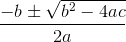
But this is NOT the quadratic formula! Well, it's not the whole story. A lot of important stuff is missing — the bits which help you to understand it and apply it. We need to have all of the following when writing the quadratic formula:
The solution for the quadratic equation
ax2 + bx + c = 0
is given by
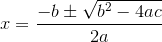
A lot of students miss out the "x =" and have no idea what the formula is doing for them. Also, if you miss out the following bit, you won't know how and when to apply the formula:
ax2 + bx + c = 0
Learning the full situation (the complete formula and its conditions) is vital for understanding.
d. Keep a chart of the formulas you need to know: Repetition is key to learning. If the only time you see your math formulas is when you open your textbook, there is a good chance they will be unfamiliar and you will need to start from scratch each time.
Write the formulas down and write them often. Use Post-It notes or a big piece of paper and put the formulas around your bedroom, the kitchen and the bathroom. Include the conditions for each formula and a description (in words, or a graph, or a picture).
The more familiar they are, the more chance you will recognize them and the better you will understand them as you are using them.
e. Math is often written in different ways — but with the same meaning: A lot of confusion occurs in math because of the way it is written. It often happens that you think you know and understand a formula and then you'll see it written in another way — and panic.
A simple example is the fraction "half". It can be written as 1/2, and also diagonally, as ½ and in a vertical arrangement like a normal fraction. We can even have it as a ratio, where the ratio of the 2 (equal) parts would be written 1:1.
Another example where the same concept can be written in different ways is angles, which can be written as capital letters (A), or maybe in the form ∠BAC, as Greek letters (like θ) or as lower case letters (x). When you are familiar with all the different ways of writing formulas and concepts, you will be able to understand them better.
Every time your teacher starts a new topic, take particular note of the way the formula is presented and the alternatives that are possible.
Do you have any tips to add? How do you figure out your math formulas? Which formulas are hardest to understand?
Good luck with understanding math formulas!
You may also like...
Ten Ways to Survive the Math Blues
See the 84 Comments below.


20 Feb 2009 at 1:42 am [Comment permalink]
Dear Sir
thank you for your nice and spiring articles. Thank you again
20 Feb 2009 at 8:22 am [Comment permalink]
Hello,
If you could help me review dosage calculation for nursing?
Any help would be appreciated.
Thanks,
20 Feb 2009 at 4:28 pm [Comment permalink]
Dear Sir,
Receiving News Letter concerning IntMath is wonderful. This will definitely enable me to provide valuable information to my students and help them to encourage in Maths.
Thanks once again.
20 Feb 2009 at 9:47 pm [Comment permalink]
Hello, Am very greatful , very impressed and more motivated by your article. I hope this will make me improve my interest 2wards mathematics. Thanks very much,
20 Feb 2009 at 10:48 pm [Comment permalink]
Thanks,,,,,because math formulas are easy to memorize but hard to use it....so its important to understand it....
its all hepfull...i'm so gratefull.....thnx*10
21 Feb 2009 at 2:53 pm [Comment permalink]
thanksssss............
I am impresed to see the tricks of mathematics formula's..........
maths is my faviourate sub. and 4 me obivously maths formulas are easy to understand.........i am greatful to log on this wonderful site.........
again thanks........
21 Feb 2009 at 4:18 pm [Comment permalink]
hey thanx for the general info abt math formulae but can u just throw some more light on how to remember the formulae based on .......integration.......reduction formulae........rememberin expansons like dat of 'e', ''sin', log(1+x) etc....these get the hell outta me........
pls
pls help me out wid these
24 Feb 2009 at 2:56 pm [Comment permalink]
I really thankful to IntMaths newsletter to advice me on how to understand maths formulae…..but i really very much oblidge to yours if you give us tips and points about short methods and tricks used in all type of exams…
Thanking You!
MMs
25 Feb 2009 at 2:15 am [Comment permalink]
I have a suggestion to add.... I found working through how to change the terms of the formula helped me to remember the general formula. A very simple way to explain is... speed = distance/ time and also distance = speed x time. but I use this for many of the rearranged formulae needed in say mechanics or with the identities in trig. They were hard at first but I make a game out of seeing how many different ways I can rearrange them
25 Feb 2009 at 8:53 am [Comment permalink]
Great suggestion, Carol.
Permit me to add to your suggestion. It's important to understand the units for each of the permutations, since this helps us to understand what the formula gives us.
So speed = distance/time has units "m/s" and distance = speed x time has units "m".
For complicated formulas, this is certainly worth doing.
26 Feb 2009 at 10:10 am [Comment permalink]
Great article thanks,
Understand how to derive and manipulate formulas inside out. Memorizing helps, but don't bank on it, as there are simply too many. Of course, basic definitions and methods have to be known. And you would probably inadvertently remember a few others by using them repetitively.
Maths is always consistent, and there aren't exceptions to the fundamental rules. A solid grounding in algebra and techniques is the key. When you do encounter a new technique or perspective, take note of it.
Then you can derive quite a lot in quadratics, trigonometry, series, etc. with relative ease, and you'll start to gain new insight and confidence - Internalize your skills so it becomes secondary to problem solving.
26 Feb 2009 at 10:51 am [Comment permalink]
Hi Keerthi,
Perhaps the Taylor and MacClaurin Series would help you with those expansions? It looks more scary than it really is.
26 Feb 2009 at 4:44 pm [Comment permalink]
this site is the most understandable math equationi've ever seen..
thank you for being such blessed and in turn blessing others...
28 Feb 2009 at 6:28 am [Comment permalink]
Dear Sir,
I am more confuse at applying the fomular than remembering it especially in differentiation and integration, sometime you forget to add a one or divide by the power or using the wrong substitution. Thanks to IntMath picking it up slowly.
28 Feb 2009 at 9:16 am [Comment permalink]
Hi David
In a future "Tips" article I will talk about the issue of differentiation and integration formulas and processes. Yes, it's not surprising that it becomes a gluggy soup after a while.
1 Apr 2009 at 3:20 am [Comment permalink]
I have to take a very important test tomorrow 4/1/ and it is on formulas. I am older and never had formulas and have no Idea what I am doing. Is there anybody out there who can shoot me a email on what the H---! a formula is and how to conquer it? or just a article that explains .........anything at this point.
Thank you so very much!!!!
1 Apr 2009 at 8:34 pm [Comment permalink]
Hi Jerelyn
There are thousands of formulas! Please give more information on the kind of thing that you are trying to understand and maybe I can help.
1 Apr 2009 at 10:02 pm [Comment permalink]
Zac
Thank you so much for the help. I have no idea what kind of math formulas I need. Just the basics on how to do one. My test is today so I do not have much time. With the information you sent I have a little more knowledge..................Or I just think I do.. Anyway thanks again. It is nice to know there are still people out there willing to help a stranger.
15 May 2009 at 6:02 pm [Comment permalink]
[...] give tips on How to Understand Math Formulas posted at [...]
31 May 2009 at 8:33 pm [Comment permalink]
This newslettter has been a Godsend to Me too. I wish some of the articles, like on how to study had come out a week or two before they did, but, when they did, they hit home. Thank You
for caring enough to try to help! God Bless You!
31 May 2009 at 8:38 pm [Comment permalink]
You're welcome, Sharon. Glad it was useful to you!
29 Jun 2009 at 3:52 pm [Comment permalink]
Writing the formula again and again is the most effective way of familiarizing any formula. It works for me, it may work to others.
11 Aug 2009 at 1:18 pm [Comment permalink]
yes i do agree that in writing a formula one could remember the formula, furthermore if one knows and understand the principles behind such formula the better he/she has control of such a formula. Thats all thanks.
4 Sep 2009 at 6:33 pm [Comment permalink]
How can you understand this serious math?
13 Sep 2009 at 7:38 pm [Comment permalink]
how i solve (a+b)2 formula
13 Sep 2009 at 8:51 pm [Comment permalink]
Hi Fazalerabbi. Do you mean how to expand (a+b)2? See The Binomial Theorem, where it tells you all about it.
1 Jan 2010 at 3:04 pm [Comment permalink]
[...] of squareCircleZ offers some valuable advice for students in How to understand math formulas. This is a great follow-up to his article How to learn math [...]
25 Feb 2010 at 5:14 am [Comment permalink]
hey what is the 0 point on a kelvin scale?
25 Feb 2010 at 2:19 pm [Comment permalink]
0° Kelvin is absolute zero - the temperature where nothing vibrates, so there is "no heat".
See Kelvin
28 Feb 2010 at 12:21 am [Comment permalink]
thanks for every tip you have given.
15 Apr 2010 at 9:01 pm [Comment permalink]
Thank you so much! This is a great article and helped me a lot with my recent math test.
I always enjoy squareCirclez!
22 Apr 2010 at 9:03 pm [Comment permalink]
good one. but how to memorize all formulas that are similar to each other?
something like this, in queuing theory..
Basic Queuing Theory Formulas [PDF] [No longer available.]
22 Apr 2010 at 10:11 pm [Comment permalink]
Stephen - do you seriously have to memorize all of those?
Assuming you do, here are some suggestions:
(a) Depending on the time you've got, spread the task out over a period of weeks, learning one per day (and revising all the ones learned so far each day as well).
(b) Many of these formulas have associated graphs. Most of us have a better visual memory than a "formula" memory, so I would learn the graph along with the formula.
(c) Learning in isolation with no meaning is difficult, so you need to learn at least one example along with each formula. This of course also helps you in exam preparation. (This is a bit like learning a foreign language - it's really hard to remember long lists of vocabulary, but much easier to remember sentences, especially if they are funny or a bit bizarre. This last part is important - if you can turn each one into a story of some sort, it can make the process easier. Here's some background on this idea.)
(d) The conditions for each formula are important to know, but can also help to remember the formula.
(e) It may be good to learn all the notation first (like W bar, P*m, etc). This is easier than trying to learn the whole formula as a first step, and reduces the memory load when you learn all of it later.
Good luck with it!
25 Apr 2010 at 12:24 am [Comment permalink]
please i suggest that you provide simplified notes with many worked exmples for A level mathematics.
It will be better for us to understand mathematics and apply it any where in the wolrd as said un the advise box that "Dont read for tommorows test but instead for the future.
15 Jul 2010 at 8:12 pm [Comment permalink]
I think units are very important for mathematical formulas. For example, I could never remember the formula for density, but I remember that the unit is g/cm^3. g is for mass, and cm^3 is for volume, so I could know the formula is mass/volume. Of course this technique is not applicable in some formulas like the quadratic formula, but it is very useful for some formulas, e.g. speed is m/s and therefore is distance/time.
18 Jul 2010 at 11:36 am [Comment permalink]
Your learning style is similar to mine. I would rather learn how to derive formulas than just learn them by rote. Most of the trigonometric formulas are easier to derive from quickly drawing a diagram (probably a right triangle or unit circle), rather than trying to learn them (since they have many similarities and small differences, which are usually hard to remember).
9 Nov 2010 at 4:15 pm [Comment permalink]
Pleaes tell us the mechanism for creating the formula,means if i have a situation how the mathematicall formula solve it? Or how can we say this particular formula solve our problem?
i think you understands wat i wana say.
please reply.....
10 Nov 2010 at 6:24 am [Comment permalink]
Hello Jamal. This is a very important skill but is neglected in a lot of school mathematics. The solution starts here: applied verbal problems, proceeds through many topics to applications of parabola (see towards the bottom of the page) and is still going at Applications of Laplace Transform.
In other words, each topic area has its own way of setting up equations and solving them. And that's what makes it interesting!
22 Dec 2010 at 8:26 am [Comment permalink]
Hello!
I have skimmed the text, since I am looking for specific material. I have problems do read and apply formulas. Could you suggest books talking about how to READ and interpret formulas ? Actually, I don't know if there is a specific field in Mathematics, so I would be grateful if you could help me.
I simply found a mathematical proof using induction and I really can't understand this.
Thank you !
24 Dec 2010 at 4:41 pm [Comment permalink]
I don't have an actual recommendation for you. Perhaps someone needs to write such a book!
This Google book search may be a good place to start looking.
There is a lot around on proof by induction. Hopefully one of those references helps!
8 Feb 2011 at 5:20 pm [Comment permalink]
Thanks a lot. Your guide is of great help to my maths problems.
23 May 2011 at 12:24 am [Comment permalink]
this is awesome. or better than awesome..:)
30 May 2011 at 11:12 pm [Comment permalink]
thank you Mr Murray, this is a good guide. but where can i get the distribution like the [poisson, binomial and normal?
4 Jun 2011 at 12:44 pm [Comment permalink]
Liina, the sections you are looking for are in this chapter: Counting and probability.
6 Jun 2011 at 6:05 pm [Comment permalink]
nice encouragement. I am second year student at bondo university college and more so lineaer algebra is the most curious unit help me come out TO UNDERSTAND IT.
24 Jun 2011 at 10:11 pm [Comment permalink]
Hi Murray,
I just finished reading the article "How to Understand Math Formulas" on your website.
You make some excellent points. I am always searching for ways to improve understanding of formulas for my students at the community college. However, item e - "Math is often written in different ways — but with the same meaning:" contains a typo. In the paragraph discussing the different ways "half" can be written, the ratio should read "1:2" not "1:1".
Regards,
Jana
25 Jun 2011 at 9:36 am [Comment permalink]
Hi Jana and thanks for your positive feedback. The ratio 1:2 implies there are 3 parts - the first being one unit and the second part being 2 units. So 1:2 suggests the first part is (the fraction) 1/3 of the whole and the second is 2/3 of the whole as in the first diagram below.
The ratio 1:1 indicates each part is of equal size, so they are 1/2 each, as the second part of the diagram shows.
Update: A reader was still not convinced about this. It is certainly true that in the first diagram, the size of the left portion is 1/2 of the size of the right portion.
But in the second diagram, the left portion is 1/2 of the whole thing.
We need to be careful about fractions, percents and ratios - and we need to state clearly if we are talking about comparing one portion with another portion, OR if we are comparing one portion with the whole thing.
25 Jun 2011 at 8:58 pm [Comment permalink]
Hi,
Upon reflection, I agree with what you are saying. Ratios involve comparing 2 quantities (let's say item A and item B). Letting the numerator be item A then 3/5 would be 3:2 with the physical example of 3/5 of the whole contains item A and 2/5 of the whole contains item B. Another example . . . 4/7 would be 4:3 with the physical example of 4/7 of whole contains item A and 3/7 of whole contains item B.
Similarly, if you are looking at the odds of an event. if an event has the probability of 1/5 occurring the odds are 1:4.
Unfortunately, there is inconsistency as to the meaning of the ":" in mathematics. There are numerous instances where the colon ( ":" ) is being used to represent division. Due to the multiple uses of the colon, the context of the application is paramount.
Regards,
Jana
28 Jun 2011 at 1:00 am [Comment permalink]
Coming from someone who is not a math expert, this information is very helpful. It clicked that math is just like learning another language.
9 Aug 2011 at 12:00 pm [Comment permalink]
Thank you sir for giveing me your knowledge of maths basic
10 Aug 2011 at 2:50 pm [Comment permalink]
Thank you,really I see it very intreseting and understandable.
13 Sep 2011 at 3:28 am [Comment permalink]
to understand maths formulas is by practising them everyday,the more i practice the more i know them.but when i dont practice,they become difficult for ME.THANK U SO MUCH.
4 Nov 2011 at 5:36 pm [Comment permalink]
Gr8 site !! Wonderful articles.. healthy comments and replies !
16 Dec 2011 at 8:07 am [Comment permalink]
Below is a problem and I think the answer is "B". I came up with the answer through proportions. I don't know the formula to prove or disprove this. Does anyone know the formula?
1 + 2/3
________ = ?
3/4
A. 8/3
B. 20/9
C. 17/9
D. 5/4
E. 10/9
16 Dec 2011 at 4:09 pm [Comment permalink]
@James: Yes, the answer is B. There's no "formula" for manipulating fractions - it's more of a process based on balancing (like a lot of math.)
One way to do it is to multiply top and bottom of your fraction by 12 (the lowest common multiple of 3 and 4).
20 Dec 2011 at 10:30 am [Comment permalink]
Thank you so much for your reply and help. I feel stupid for not seeing it earlier. It's so simple now that I can see it. 🙂
30 Jan 2012 at 12:12 am [Comment permalink]
Exactly right math is just like a foreign language that we all start learning at a young age. Great tips on suggestions with the sticky notes.
30 Jan 2012 at 11:52 pm [Comment permalink]
My opinion is that learning formulae is wrong from scratch. Understanding the logic behind it is better.
Somehow, the best example to this is the formula for the area of a disk. The circumference is not so interesting, for the definition of pi is given by the circumference divided by the diameter. (Actually, the circumference formula is quite interesting too, because pi can also be defined as the min x in positive real numbers satisfying sin x = 0 and cos x = 1. It might be a little bit hard to find the circumference formula this way, but it is possible.) But the area might not be so obvious and I know that. Learning a formula you have no idea where it comes from however is just as bad as not learning it, for it does not make sense. I do know a simple proof of this however, involving no complex mathematics, on the Wikipedia page for the area of a disk. It unfolds a disk into a right triangle with the height r and the base length 2pir, and then the proof is easy.
10 Mar 2012 at 1:58 pm [Comment permalink]
I still don't understand how to go abaut it, pls help me.
10 Mar 2012 at 3:17 pm [Comment permalink]
@Mathew: What specifically are you having trouble with?
4 Apr 2012 at 3:56 pm [Comment permalink]
I don't seem to have any trouble understanding mathematical formulas or equations, because, maybe due to the fact that my favourite subject in school was mathematics!
Whatever you enjoy, you do better at, because you absorb it, you become more involved in it, whether it happens to be sports, or music or another form of art, or whatever subject it happens to be.
I really agree with Starfall in that it’s the logic that’s behind math that really has to be understood, rather than the memorizing of equations that helps one get an A in math. I have in my library of books: Schaum's Outlines - Mathematical Handbook of Formulas and Tables. It provides an entire 217 pages (give or take) of formulas, notwithstanding the rest of the book covering the tables. Now, if one would go and memorize the complete publication, one would have to agree that based on that, and that alone, the person would still not be GOOD at math. It takes true understanding to help one get by in any subject, based on accurate knowledge, and this, I would say, comes from experience, plain and simple.
A good math teacher, and one who does so in a fun and entertaining manner, is far better in getting a student to understand what the right answer should be, is also extremely valuable. Otherwise the result remains as we are hearing on this board, the great difficulty of many in understand mathematics. I was always truly amazed in my math teacher’s ability to come to grips with formulating a real picture of what was required to find the answer to a question, especially ones that were “word questions,” and then graphically show how this gains the required answer to solve the question. That is what I call the “art” of math. It’s a real skill that I attributed to simply the experience of years of crunching numerous examples, the sheer number of questions in the textbook, over and over and over, day in and day out, to students. That’s all they do, and they gain this art in the attempt to help some come to a fundamental understanding of math. Now most will not go on to use such in their education or complete a degree in higher mathematics, but it is to help teach the student to think abstractly. I have come to believe that that is the goal of all math teachers.
What I have trouble with and maybe others have come across this as well, is how to read and repeat in the spoken form, an equation that uses unfamiliar symbols, that I have never seen before. I read for fun and because I have a real interest in, the subject of particle physics. They use a lot of mathematics that is unfamiliar to much of the population because of the advanced level it takes to understand the concepts that one needs to form a simplified picture of what is being discussed, and that have not been formally taught in the subject. How do I understand what is needed to visualize such a formula, because I do know that these may use a short form or a condensed formula that if one knows the subject thoroughly, could expand in any of the number of dimensions that are required, with all the proper new symbols that result from the expansion. What order does one say the names of the symbols and/or the way it should be said, so that one listening could write down in the right format what was said? Where do I go to check and see if I have written down the formula correctly and can even be correct in what I have interpreted what I have seen and written down? What I am saying, in effect, is there an application available that will allow one to enter a formula in and have the program read it back to you as it would be read properly?
To hear a math equation spoken to you, and even possibly explained as to what it means by what the equation contained, as constants, symbols and so on, would be extremely valuable in helping students of just about any grade or level of learning to comprehend what is being taught.
I look forward to the time when all that can be computed will be stored and can be retrieved so that others can learn at their own pace. A sort of online virtual teacher. That would be a great school to be educated at!
Craig.
4 Apr 2012 at 7:23 pm [Comment permalink]
Thanks for your thoughtful additions, Craig.
I'm interested in spoken math at the moment, as I'm putting together some things for people with visual challenges.
Have you come across Design Science's MathPlayer? It can speak equations in MathML form. But I suspect it will also choke on the more unusual symbols you are talking about.
12 Apr 2012 at 1:08 pm [Comment permalink]
Understanding math is like learning a new language. The reason, I say that, is because the author said it and I agree with him. It is like taking the first baby steps or leaning the language of math. You need to know the symbols, meaning, and etc... Just keep practicing and practicing, the more the better you will be with math. Math is always consistent, and there is no exception. I love Math.
20 Apr 2012 at 2:30 am [Comment permalink]
I will give another example.
The post refers to the quadratic formula, but is it really enough just to know the formula, when it is easy to obtain it?
Lemma. The distributive property of multiplication indicates that (a+b)^2 = a^2+b^2+2ab.
Proof. (a+b)(a+b) = a(a+b) + b(a+b) = aa + ab + ab + bb = a^2+b^2+2ab.
Theorem. The quadratic formula stated above.
Proof. ax^2+bx+c = 0
x^2 + bx/a + c/a = 0
x^2 + bx/a = -c/a
x^2 + bx/a + (b/2a)^2 = (b/2a)^2 - c/a
(Lemma) (x + b/2a)^2 = (b/2a)^2 - c/a
x + b/2a = +/-sqrt((b/2a)^2 - c/a)
x = +/-sqrt((b/2a)^2 - c/a) - b/2a
= (+/-sqrt(b^2-4ac) - b) / 2a
= [-b +/- sqrt(b^2-4ac)] / 2a
Q.E.D.
The proof is not any hard, while still students do not know about it. This is something which should be further examined. Teachers should focus on these concepts rather than giving the formulae and just telling the students to use it afterwards.
1 Oct 2012 at 9:53 pm [Comment permalink]
Maths is a exciting subject. i love to study maths very much...
17 Dec 2012 at 5:12 am [Comment permalink]
Murray I like the way that you are delivering lessons and its highly appreciated one and you are well respected human and you are deserve every thing good, and i think world will never forget your effort that you contribuited world.
your faithfull student
imaan mohamed
17 Dec 2012 at 5:33 pm [Comment permalink]
@Imaan - Thank you so much for your kind comments!
21 Dec 2012 at 5:01 pm [Comment permalink]
I found it difficut to understand maths formulars until i log to this site and get the tips about formulars, i'm so happy, is quite educating, thanks mr. Murray.
28 Dec 2012 at 2:35 pm [Comment permalink]
it is useful.this news forward for other people
18 Jan 2013 at 10:29 pm [Comment permalink]
its very usefull but dont we have funny tricks that can be remembered easily
29 Jan 2013 at 9:42 pm [Comment permalink]
I like the idea of posting the equations around you so you can see them everyday. I do think this would help because often I find my self trying to remember first before looking. I can't always remember them because I am just not that familiar with them.
27 Feb 2013 at 6:23 pm [Comment permalink]
sir, first of all, thank you very much for publishing this kind for us...maths is what i want to study but when i tried myself its like a tortoise trying to walk like a man.....but after reading this stuffs i think i can do it..again.. Thanks.
10 Mar 2013 at 12:03 pm [Comment permalink]
I think you don't have full information of quadratic equations. You must explicitly indicate that, "a must not equal to zero". That is one of the necessary condition to hold all of your above explanation.
10 Mar 2013 at 1:58 pm [Comment permalink]
@Uday: But if a = 0, then it's not a quadratic polynomial, and the quadratic formula does not apply!
3 Jun 2013 at 6:49 am [Comment permalink]
I'm pretty sure that the reason I'm not as successful with mas as I am in other areas is because I've always moved on to new material without fully understanding past concepts. It's been an on going cycle since 6th grade when math started becoming really difficult for me. I learned math extremely slowly. Once I mastered an equation or concept the class had already learned an additional two or three. I'm learning that math takes practice and hours of it.
29 Oct 2013 at 11:07 pm [Comment permalink]
I have a huge problem with maths and what I have noticed is that I like working alone and researching. Going back into time i did not start with pure maths I did mathematical literature which mostly concentrates on a lot theory e.g finance, distance, measurements, weight and others. But now I want to go to university and its a must that i do pure maths. I have a lot of resources at home and in other places its just that most of the time I lose inspiration and that makes me leave my work but i do not give up easily. Concluding, I need maths but without the basics I don't have the foundation to loving and practicing maths occasionally. So guys in any way you can help i am all ears and ready for a math journey. Thanks . Andrew
30 Oct 2013 at 4:22 pm [Comment permalink]
@Andrew: You could always use Kahn Academy - a lot of students find it good for self-study because it helps you to see how you are progressing, which can help keep up the motivation.
14 Apr 2014 at 2:29 pm [Comment permalink]
I think math is similar to taking in another dialect. The reason, I say that, is on account of the creator said it and I concur with him. It is similar to taking the first gradual steps or inclining the dialect of math. You have to know the images, significance, and so forth… Just continue rehearsing and polishing, the more the better you will be with math. Math is constantly reliable, and there is no exemption.I also love Math Subject and i recently completed my Graduation in Mathematics.
5 Jan 2016 at 4:10 am [Comment permalink]
I think math teachers should concentrate on teaching the story behind each formula or any confusing subject rather than just giving the learners information and expecting them to understand it. I find it quite interesting to know proofs of formulas so that I can understand how it came about and understand where to use the formula.
5 Jan 2016 at 8:39 am [Comment permalink]
@Lehasa: Unfortunately, many students get lost in the proofs, but can be quite productive when they know how to apply the formula (rather than knowing where it comes from).
So for math teachers, it's important to find a balance between the "must know" and the "good to know" elements of a mathematical concept.
12 Jan 2016 at 4:18 pm [Comment permalink]
More and more easy methods you have shared to remember math formulas. This is really very useful. Thank you for sharing this great article.
7 May 2016 at 4:45 pm [Comment permalink]
all I want to say is that your a really helpful person.
24 Jan 2018 at 7:02 pm [Comment permalink]
You are realky helpful and thanks for making it easy for me to understand maths
24 Mar 2018 at 12:19 am [Comment permalink]
Thank you for making it easier to understand math with this great article.