Making math accessible for the blind
By Murray Bourne, 04 Nov 2009
I had an interesting and quite powerful experience this week. I went on a Dialog in the Dark "tour". You go into a building in which the rooms are in pitch darkness and you are guided around by blind people. You experience crossing a "street", walking in a park (stumbling over bicycles and bridges) and buying a drink at a cafe. One thing I hadn't thought about before — getting money out of an ATM. How could you be sure you got the right amount and what if there was an error meesage?
It was very unnerving and disorienting to not be able to see at all for over an hour.
Our guide went to special schools until his senior high school and university, when he was on his own. When young, he could only read using large text books, but his eyesight has deteriorated since then and now his great joys are audio books and computer screen readers.
I've had a special interest in helping blind people since university days when I was involved in some community work. We used to visit blind people and do various chores for them like reading out letters (it was pre-computer days). I got quite interested in how blind people learn to play music (via braille, and they would need to read a bit, memorize it, then play) and mathematics.
I came across this interesting resource recently: Hadley School for the Blind - abacus resources.
They talk about how useful the Chinese abacus is in helping blind people learn math. The Cranmer Abacus has a red felt backing that prevents the beads from slipping. In a normal abacus, the beads are meant to slip easily for fast calculation.
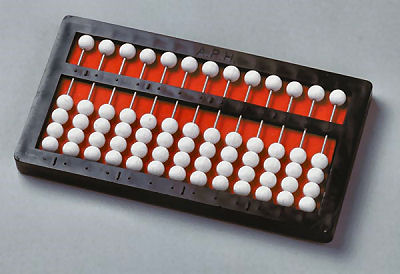
Cranmer Abacus
Of course, we should not restrict the use of the abacus just to blind people. It can be a great way for any student to learn concepts like place value and it is especially good for tactile, kinesthetic learners.
The Japanese still use the abacus, even when they are surrounded by computers and calculators. It's great to watch an experienced abacus practitioner.
Some more resources to help blind (or partially sighted) math students:
Scientific Notebook (article by Susan Osterhaus on how this software can provide usable output for blind students). Here's more from Susan at the Texas School for the Blind and Visually Impaired.
Article on Nemeth Code.
Access to Mathematics by Blind Students, by Arthur I. Karshmer and Chris Bledsoe, University of Southern Florida.
I encourage you to learn more about the challenges faced by blind people and the ways you can help.
See the 9 Comments below.

