Today is “e” day (Feb 7th)
By Murray Bourne, 07 Feb 2010
"e" is one of those amazing numbers that arises naturally in the scheme of things.
Today, 2/7, is celebrated as "e" Day, since the first 2 digits in the number "e" are 2 and 7.
Other special numbers include "pi" (π = 3.141592653..., celebrated on Mar 14th), which is the circumference of any circle divided by its diameter; and "phi" φ = 1.6180339887..., which is the so-called "beauty ratio". These numbers are irrational (that is, their decimals go on forever and never repeat).
e is also an irrational number and it has value:
e = 2.718281828459...
The number e was "discovered" by several mathematicians (Oughtred, Huygens, Jacob Bernoulli, Mercator and Leibniz) but they didn't quite know they had stumbled on it and didn't necessarily know its significance at first.
There are some curious properties of e, one of which is that it's the limiting value of this expression:
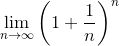
What does this mean?
Let's substitute some values to see what this limit expression means.
We start with n = 1 (we cannot start with 0, because that would give a fraction with 0 in the denominator).
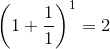
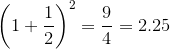
Next, we substitute n = 2:
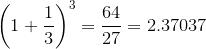
One more: n = 3
It's easier to see what's going on in a graph.

I've plotted the values after substituting n = 1 up to n = 20. We can see it's tending (getting closer to) some value. That value, marked as "e" in red on the graph, is 2.718281828459...
This function converges slowly. If I substitute in n = 1000, I only get 2 decimal place accuracy, and even if I go up to n = 100,000, I get 2.718268, which is only accurate to 4 decimal places.
A better way to find e
The value of "e" can also be found by adding the infinite sum:

The "factorial" exclamation mark, "!", means "multiply by all positive integers smaller than the number given". So
2! = 2 × 1 = 2
and
3! = 3 × 2 × 1 = 6.
We can write our infinite sum using summation notation as:

I'll show the first few terms of this sum. When n = 0, using the convention 0! = 1, we have:

When n = 1:
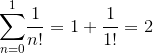
When n = 2:
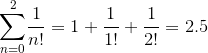
And one more, when n = 3:

This second infinite sum is a more efficient way of finding "e", since we only need to add 9 terms and we have 6 decimal place accuracy.
Why is "e" so important?
So what is e good for? See Exponential and Logarithmic Functions.
It is used extensively in logarithms (which was the only way to do difficult calculations for hundreds of years before calculators came along), exponential growth (of populations, money or drug concentrations over time) and complex numbers (which were used to design the computer or mobile device you are reading this on).
So happy "e" day (February 7th, or 2/7).
[For more information on e, see the MacTutor history.]
See the 10 Comments below.


9 Feb 2010 at 5:20 am [Comment permalink]
[...] Today is “e” day [...]
31 Jan 2012 at 1:46 pm [Comment permalink]
Pi-day is on 3-14, but Some people consider 22/7 as pi-day.
Thanks for info. about e-day.
31 Jan 2012 at 6:57 pm [Comment permalink]
In analogy with pi day (March 14th) "keeping 2 decimal places", shouldn't e day be on February 71st (or 72nd, if rounding)? 🙂 That's when my precalculus class celebrated it last year - counting forward, I believe that's some time around April 11th.
It'd be easier to do this in a non-"middle-endian" calendrical system: 27/1 (or again, 27/2 if rounding....). Actually, now that I think about it, in a "middle-endian" calendar, pi day is obvious, but e day is not (3/14 vs 2/71), while in "little-endian" calendars, pi day is nonobvious (31/4) but e day is (27/1).....
31 Jan 2012 at 7:07 pm [Comment permalink]
@Mike: Good to hear from you! Thanks for your input. But somehow, April 11th seems rather distant.
How about the idea of celebrating at 4:28 AM on the 7th February (based on 0.01828... × 24 hrs = 4 hrs 23 min). Then again, at that hour, it would be difficult to find anyone who cares! 🙂
4 Feb 2012 at 5:47 am [Comment permalink]
happy e day
"thanks for this beautifull post.
I loved it"
6 Feb 2013 at 10:21 pm [Comment permalink]
[...] But for those who have the background to understand, “It is the limit of (1 + 1/n)n as n approaches infinity (source: the almighty wikipedia). It is this [...]
18 Dec 2014 at 1:54 am [Comment permalink]
[…] sure there are other dates out there that should and could be celebrated (i.e. e Day). So don’t feel too bad if you’re not taking a day this week to graph a Gingerbread […]
7 Feb 2017 at 4:05 pm [Comment permalink]
[…] “e” Day – (Strictly for math geeks). […]
7 Feb 2017 at 10:52 pm [Comment permalink]
[…] Today is “e” Day! […]
27 Jan 2020 at 1:18 am [Comment permalink]
[…] Murray Bourne: Today is “e” day (Feb 7th) – auf: intmath.com am 7. Februar 2010 (englisch) […]